Palgongsan Hiking Guide: Gatbawi Buddha and Summit
A practical guide to hiking Palgongsan National Park near Daegu — the Gatbawi stone Buddha pilgrimage, Donghwasa route to Birobong summit, and how to get there.
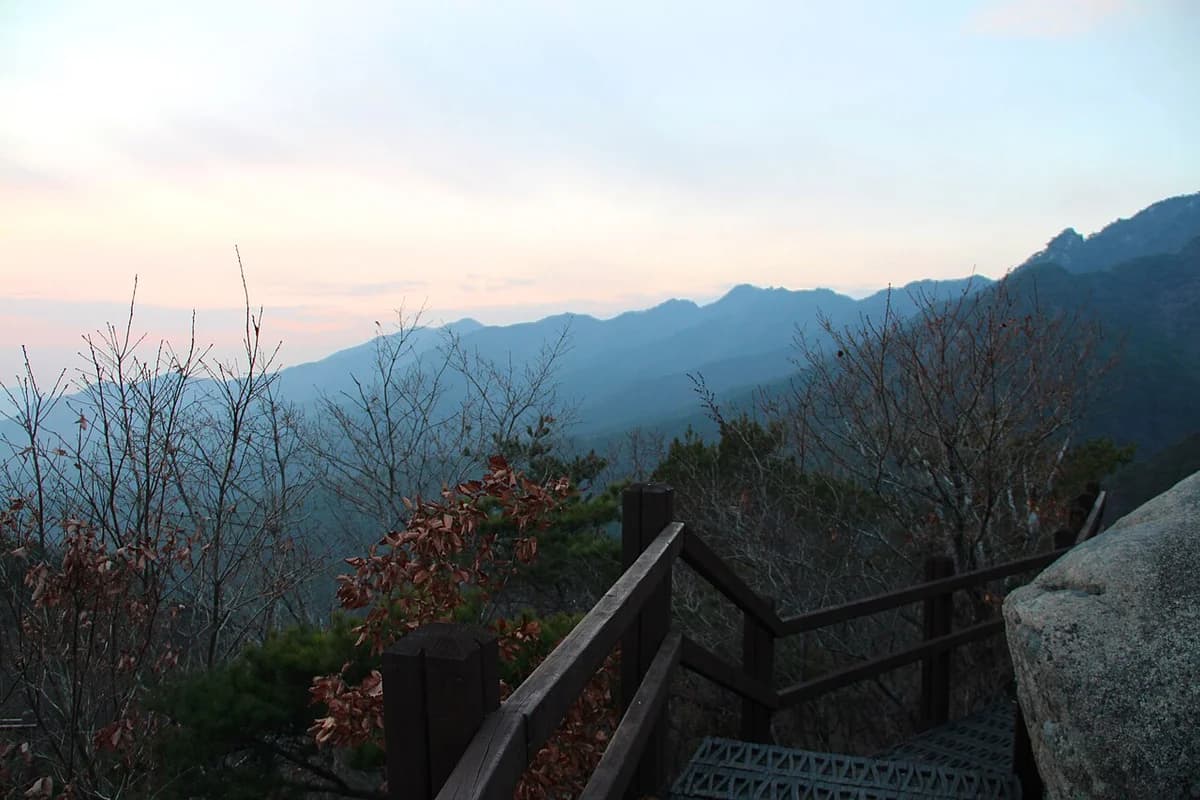
Palgongsan rises to 1,193 meters northeast of Daegu, South Korea's fourth-largest city — approximately 3.5 hours from Seoul by KTX and bus. Designated as Korea's 23rd national park in December 2023, the mountain spent 43 years as a provincial park before the upgrade. The name means "Mountain of Eight Lords," commemorating eight generals who died defending the Goryeo founder Wang Geon in the Battle of Gongsan in 927 CE — one of the most significant military engagements in Korean unification history.
Most people don't come here for the summit. They come for Gatbawi. At 850 meters on Gwanbong peak, the Gatbawi stone Buddha — a Unified Silla-era sculpture carved directly from living granite — sits facing east, wearing a flat stone hat. It is Treasure No. 431 and the center of a folk tradition that draws roughly 300,000 pilgrims annually: one sincere prayer, one wish granted. The 1,000-plus stone steps to reach it are as much a pilgrimage as a hike.
Above Gatbawi, the ridge extends west to Birobong at 1,193 meters — the highest point and the destination for hikers wanting a proper summit. The Donghwasa route from the park's largest temple climbs through forest and hermitages to a granite ridge with views across the Nakdong River basin. A cable car provides access to the mid-elevation for those who want the scenery without the full ascent.
Quick Info
Quick summary for planning your Palgongsan hike at a glance.
- Location: Daegu Metropolitan City / Gyeongsan / Yeongcheon / Chilgok, North Gyeongsang Province, South Korea
- Highest Peak: Birobong, 1,193m
- Park Area: 126 km²
- Difficulty: Easy (cable car) to Hard (full traverse)
- Best Time to Visit: October (autumn foliage), April–May (azaleas), January 1 (sunrise)
- Entrance Fee: Free (cable car: 13,000 KRW round trip)
- Park Designation: 23rd National Park (2023)
- Travel Time from Seoul: ~3.5 hours by KTX + bus
Trail Overview
| Trail | Distance | Elevation Gain | Time | Difficulty | Best For |
|---|---|---|---|---|---|
| Gatbawi Pilgrimage | ~2km one-way | +300m | 1–1.5h up | Moderate | Stone Buddha, sunrise, pilgrimage |
| Donghwasa to Birobong | 8.5km round trip | +700m | 4–5h | Moderate–Hard | Summit, temple, ridge |
| Pagyesa to Mitabong | 6–8km round trip | +500m | 3.5–4h | Moderate | Quiet valley, solitude |
| Cable Car + Walk | varies | minimal–300m | 1–3.5h | Easy–Moderate | Families, scenic views |
| Full Traverse | 27.7km | +2,000m cumulative | 12–14h | Hard | All peaks, experienced hikers |
Why Palgongsan Is Worth the Trip
Palgongsan occupies a unique position among Korean mountains. It is the newest national park in the country, upgraded from provincial status in 2023 after decades of advocacy. The 927 CE battlefield beneath it produced one of the founding legends of the Goryeo Dynasty — the general Sin Sung-gyeom donning his king's armor to draw enemy fire, dying so that Wang Geon could escape. The mountain's name records the eight officers who fell that day.
The Buddhist heritage is concentrated and varied. Donghwasa, the park's central temple, is a major Jogye Order headquarters with massive stone Buddha statues and active monastic life. Pagyesa on the western slopes sits deep in a valley with a contemplative character distinct from Donghwasa's scale. And Gatbawi — second only to Seokguram in the assessment of Korean Buddhist sculpture — adds a folk-religious dimension that no other mountain temple provides.
The ecology is measurably rich: 5,296 documented wildlife species including 15 endangered, and 1,046 plant taxa with 36 Korean endemics. The park's flagship species is the marten — a mid-sized carnivore that hunts in packs of two or three, taking prey larger than itself.
For comparison, Mudeungsan offers UNESCO-designated geology near Gwangju. Odaesan has deeper forest and higher elevation in Gangwon Province. Palgongsan's strength is the combination of accessible pilgrimage (Gatbawi), proper summit hiking (Birobong), and a battlefield history that connects the mountain directly to the founding of Korean dynastic civilization.
Difficulty and Time Required
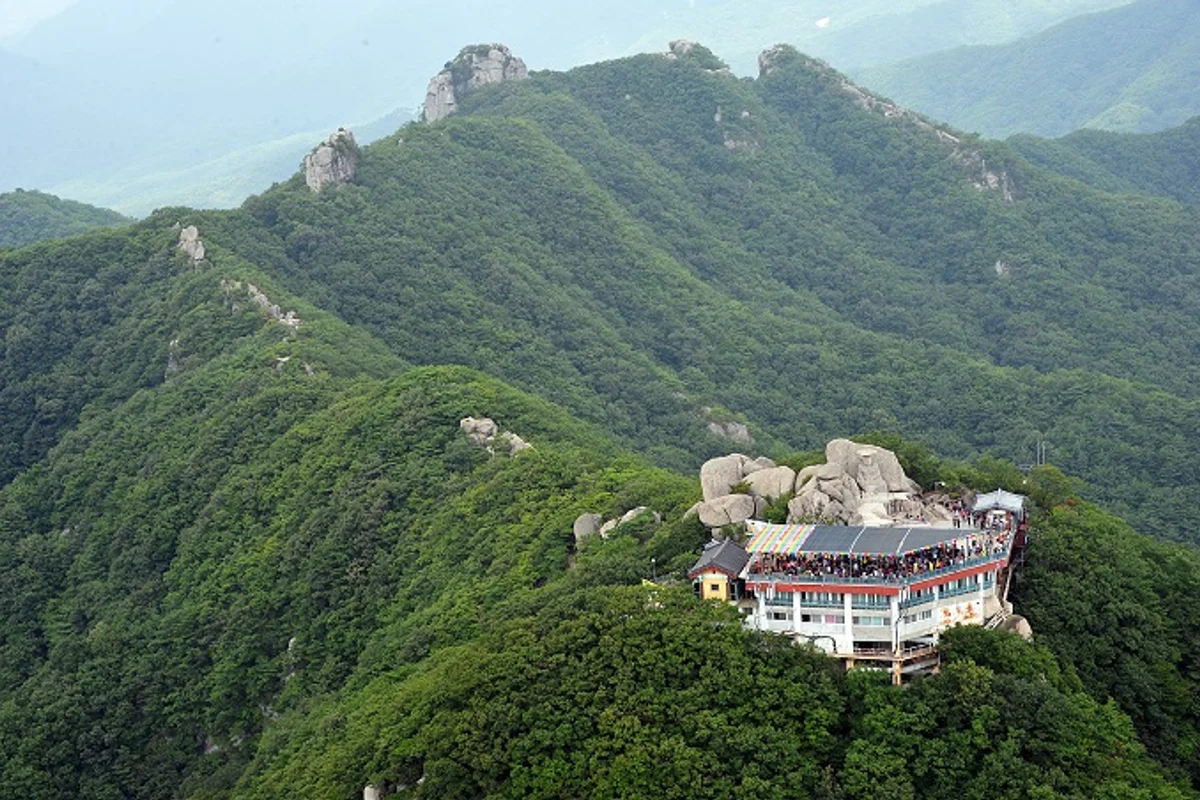
Palgongsan's trail system covers the full range. The Gatbawi pilgrimage is physically demanding — roughly 1,000 stone steps at a steep gradient — but short in distance and requires no technical skill. The Donghwasa route to Birobong is a proper half-day mountain hike with 700 meters of elevation gain, exposed granite sections with fixed ropes near the summit, and 4 to 5 hours round trip. The cable car eliminates most of the climbing for those who want the views without the effort.
The full 27.7-kilometer traverse across all major peaks is a 12 to 14 hour expedition — realistically a two-day undertaking — for experienced mountain hikers only.
The granite surfaces become slippery when wet. The upper ridge sections are exposed to wind. In winter, crampons are essential above 1,000 meters.
Trail Options
Gatbawi Pilgrimage — Most Famous
The most visited trail on Palgongsan leads to the Gwanbong Stone Seated Buddha at 850 meters. From the Gatbawi parking area in Gyeongsan, the route climbs roughly 1,000 stone steps to the summit platform.
Direct route — the stairs
The direct path is relentless: steep stone steps with minimal rest intervals, gaining approximately 300 meters over 2 kilometers. The steps are uneven in height, which makes the climb more tiring than the distance suggests. The cardiovascular demand is real — this is not a gentle temple walk. Allow 1 to 1.5 hours ascending, and expect the descent to be hard on the knees.
Alternative route — the forest path
A longer, more gradual trail winds through forest behind the temple complex. It adds roughly 30 minutes but reduces the gradient significantly. Better for beginners and families.
At the top
The Gatbawi Buddha sits on the eastern edge of Gwanbong, facing the sunrise. The sculpture was carved from natural granite during the Unified Silla period by the monk Uihyeon as a memorial for his deceased mother. The flat stone disc on the Buddha's head — the "gat" — makes it unique among Korean Buddhist sculptures. Treasure No. 431.
The tradition is specific: one sincere prayer, one wish granted. The inscription at the site reads that a drop of water, falling constantly, eventually wears through the hardest rock — and so will sincere intention. Roughly 300,000 pilgrims visit annually, with the heaviest traffic around college entrance exam season, New Year's Day, and Lunar New Year.
For sunrise photography, arrive by 5am. The sun rises directly behind the Buddha's head from certain angles — the silhouette against the dawn is the defining image of Palgongsan.
Best for: Pilgrimage, sunrise, anyone interested in Korean Buddhist folk tradition.
Donghwasa to Birobong — Best Summit Route
The central route starts at Donghwasa Temple, climbs through forest and hermitages, and reaches Birobong summit at 1,193 meters. The 8.5-kilometer round trip takes 4 to 5 hours.
Lower section — Donghwasa to Yeombulam Hermitage (1.5km, 45 min)
From Donghwasa — one of five major Jogye Order temples in Gyeongbuk — the trail climbs through forested slopes on a well-maintained path. The temple complex itself merits time: massive stone Buddha statues, multi-story pagodas, and an active monastic community. Top up water here — facilities thin out above.
Mid section — Yeombulam to upper ridge (2.5km, 1.5–2h)
The gradient steepens through mixed rock and dirt trail. The climb feels gradual at first, but the middle section steepens quickly before opening onto exposed granite near the summit. Yeombulam Hermitage at roughly 950 meters provides a natural spring and a rest point before the final push. The forest transitions from broadleaf to conifer-mixed as elevation increases.
Upper section — Ridge to Birobong (final approach)
The last 200 meters of elevation gain involve exposed granite scrambling with fixed ropes and chains. The rock is steep enough that handholds are necessary. From Birobong summit, the 360-degree view takes in Daegu's urban sprawl to the south, the Nakdong River basin, and the ridgeline extending east toward Gatbawi.
An optional loop via Dongbong (East Peak, 1,020m) adds 3 kilometers and 1.5 hours of ridge walking before rejoining the descent trail — highly scenic granite ridge work for those with time and energy.
Best for: Summit hikers, temple visit combined with ridge climbing, autumn foliage.
Pagyesa to Mitabong — Quieter Valley Route
The western approach starts at Pagyesa Temple, set deep in a secluded valley with a contemplative character distinct from Donghwasa's scale. The trail climbs to Mitabong (East Peak, 1,020m) and returns, covering roughly 6 to 8 kilometers in 3.5 to 4 hours.
Pagyesa is the quietest of the three main temple districts — the farthest from the city and the least trafficked. The route follows a forested valley with stream scenery before steepening toward the ridge.
Best for: Hikers seeking solitude, valley scenery, a quieter temple experience away from the main Donghwasa and Gatbawi crowds.
Cable Car Access — Easiest Option
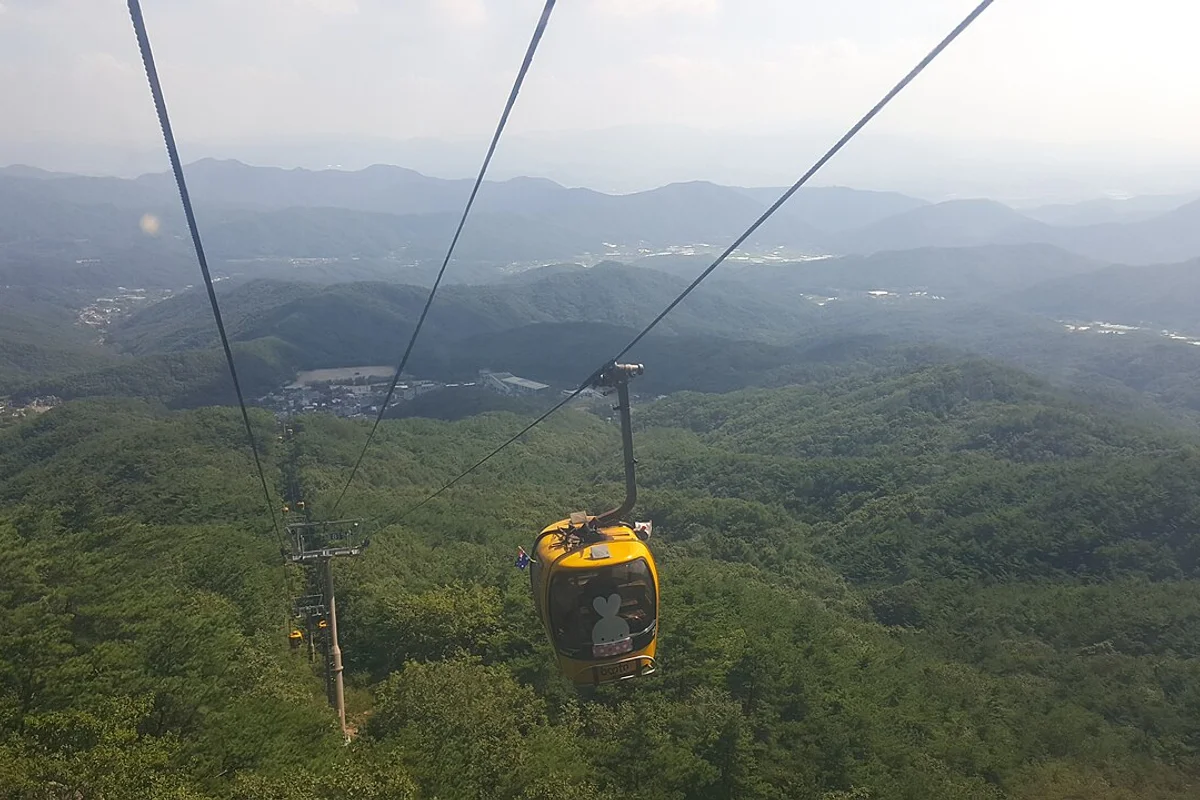
The Palgongsan cable car carries 6-person gondolas to Sinrimbong at roughly 820 meters in 10 minutes. From the upper station, additional walks of 1 to 3.5 hours reach Yeombulam Hermitage or the Dongbong ridge. Round trip cost is 13,000 KRW for adults.
Best for: Families, visitors with limited mobility, anyone who wants mountain views without a full hike.
Full Traverse — Expert Route
The 27.7-kilometer traverse from Chilgok to Gatbawi crosses all major peaks and takes 12 to 14 hours — realistically requiring two days with a bivouac near the summit. The route involves sustained ridge walking with technical scrambling sections, exposed granite, and cumulative elevation gain exceeding 2,000 meters.
Best for: Experienced mountain hikers with full gear, multi-day capability, and advance planning.
Best for Most Travelers
If you have one day at Palgongsan and want the signature experience: Gatbawi pilgrimage. The roughly 1,000 stone steps to the Gwanbong Stone Seated Buddha take 1 to 1.5 hours up. Combine with an early start for the sunrise behind the Buddha's head — the defining image of Palgongsan.
If you want a proper summit hike: Donghwasa to Birobong. The 8.5-kilometer round trip takes 4 to 5 hours with 700 meters of elevation gain, granite scrambling near the top, and views across the Nakdong River basin. Start at Donghwasa Temple for the cultural context before the climb.
If you have limited time or fitness: cable car to Sinrimbong. Ten minutes to 820 meters, with optional walks of 1 to 3.5 hours from the upper station.
Who Should Do This Hike
Palgongsan serves three distinct audiences. Pilgrims come for Gatbawi — the stone steps, the wish tradition, the sunrise behind the Buddha's head. Hikers come for Birobong — 1,193 meters of granite ridge with fixed ropes on the upper sections and views across the Nakdong basin. And casual visitors come for the cable car and the temples — Donghwasa alone justifies a half-day visit.
The Gatbawi stairs are physically demanding but require no technical skill. The Donghwasa-to-Birobong route requires hiking boots, reasonable fitness, and comfort with exposed rock. The full traverse is for experienced mountain hikers only.
The park provides free gear rental at some offices — hiking boots, poles, crampons, knee braces, and backpacks — though availability varies by location and season. Check with the eastern or western park office before counting on it.
Tips Before You Go
- Bring at least 2 liters of water for the Donghwasa route. Yeombulam Hermitage has a natural spring, but carry your own supply above that point.
- The Gatbawi stairs are steep and relentless. Take the forest path alternative if you have knee concerns.
- Wet granite on the upper Birobong sections is dangerously slippery. Avoid the summit route after rain.
- Free gear rental (boots, poles, crampons, backpacks) may be available at the park's eastern and western offices from 9am — check availability before relying on it.
- Sunrise at Gatbawi requires arriving by 5am. On January 1 and Lunar New Year, expect extreme crowding.
- In winter, crampons are essential above 1,000 meters. The Gatbawi stairs can ice over.
- A shuttle bus connects Gatbawi, Donghwasa, and Pagyesa parking areas on weekends and holidays.
- Emergency number: 119.
How to Get There
From Seoul (KTX — recommended): Take KTX from Seoul Station to Dongdaegu Station (approximately 1 hour 40 minutes). From Dongdaegu, take city bus or taxi to the trailhead — Donghwasa is approximately 40 minutes, Gatbawi approximately 50 minutes by bus.
From Daegu city center: City buses run to all three major trailheads (Donghwasa, Pagyesa, Gatbawi). A weekend shuttle bus connects the parking areas.
By car: Approximately 300km from Seoul via Gyeongbu Expressway, roughly 3.5 hours. Parking is available at all major trailheads — arrive early on weekends and holidays.
Use Naver Maps for real-time transit directions on the day.
Final Thoughts
Palgongsan is the mountain where Korean history, Buddhist devotion, and granite hiking converge. The Gatbawi pilgrimage — 1,000 steps to a Unified Silla Buddha carved from living rock, facing the sunrise, granting one wish to those who climb — is an experience that has no equivalent on any other Korean mountain. The Birobong summit adds genuine altitude and ridge scrambling for hikers who want more than the pilgrimage alone.
As Korea's newest national park, Palgongsan benefits from upgraded trail infrastructure and shuttle services that make it unusually accessible for a mountain of this scale. The battlefield history beneath it — eight generals dying to save a king in 927 CE — gives the ridge a weight that pure geology cannot. It's not the most remote mountain in Korea, but it's one of the easiest places to experience both hiking and Korean Buddhist culture in a single day.
For the best hikes reachable directly from Seoul by subway, see the full Seoul hiking guide.
Related Guides
Explore more hiking in Korea:
- Best hikes in Seoul — full overview of Seoul's mountains by subway
- Seoraksan Hiking Guide — Korea's top hiking destination
- Mudeungsan Hiking Guide — UNESCO geopark near Gwangju
- Odaesan Hiking Guide — fir forest and temples, Gangwon Province
FAQ
How difficult is the Gatbawi pilgrimage hike? The direct route involves roughly 1,000 steep stone steps gaining 300 meters of elevation over 2 kilometers. It is physically demanding but requires no technical skill. Allow 1 to 1.5 hours ascending. A gentler forest path alternative adds 30 minutes but reduces the gradient.
How do I get to Palgongsan from Seoul? Take KTX from Seoul Station to Dongdaegu Station (approximately 1 hour 40 minutes). From Dongdaegu, take a city bus or taxi to the trailhead — approximately 40 to 50 minutes depending on destination. Total travel time is roughly 3.5 hours.
What is the Gatbawi stone Buddha? Gatbawi is a Unified Silla-era stone Buddha (Treasure No. 431) carved from natural granite at 850 meters on Gwanbong peak. The sculpture wears a flat stone hat and faces east. A folk tradition holds that one sincere prayer here will grant one wish. Approximately 300,000 pilgrims visit annually.
What is the best time to visit Palgongsan? October for autumn foliage — mid to late October is peak color. April to May for azaleas. January 1 for the Gatbawi sunrise tradition, though expect extreme crowds. Spring and autumn weekdays offer the best balance of weather and solitude.
Is the Palgongsan cable car worth it? Yes, for visitors who want mountain views without a full hike. The cable car reaches Sinrimbong at roughly 820 meters in 10 minutes (13,000 KRW round trip). From the upper station, optional walks of 1 to 3.5 hours reach hermitages and ridge viewpoints.
What should I bring for hiking Palgongsan? Hiking boots with ankle support for the Birobong route. At least 2 liters of water. Sun protection and a wind layer for the exposed ridge. In winter, crampons are essential above 1,000 meters. Free gear rental is available at the park offices.
Continue exploring Korea's mountains
More routes, same honest field notes.
Related guides
Same region
EasyJuwangsan Hiking Guide: Tuff Cliffs and Jusanji Pond
A practical guide to hiking Juwangsan National Park — a UNESCO Global Geopark with volcanic tuff cliffs, three valley waterfalls, and willow-lined Jusanji Pond.
Same region
HardGayasan Hiking Guide: Haeinsa and Tripitaka Koreana
A practical guide to hiking Gayasan National Park — the Haeinsa Temple route to Chilbulbong, the Manmulsang scramble, and UNESCO Tripitaka Koreana woodblocks.
Same region
EasyHwangmaesan Hiking Guide: Azalea Plateau and Summit
A practical guide to hiking Hwangmaesan — Korea's most accessible alpine plateau with one million pink royal azaleas in May and silver grass fields in October.